Introduction
Colon cancer screening tests are designed to find cancer early or prevent it by detecting polyps before symptoms appear. Different tests serve different risk levels, and choosing the right one depends on age, history, and personal preference.
Colon cancer screening is one of the most effective prevention tools in modern medicine—yet it’s also one of the most misunderstood. Many people wait for symptoms that never come, while others avoid screening due to fear or confusion about the tests themselves. This article explains colon cancer screening tests clearly and calmly: how each test works, what it detects, when it’s used, and how professionals decide which option fits best.
Colon cancer usually develops silently.
Most early-stage cancers and polyps:
Do not cause pain
Do not change digestion
Do not trigger warning signs
From real-world screening programs, the majority of serious findings come from people who felt completely normal.
That’s why screening is based on risk and age, not symptoms.
SERP Gap: What Most Screening Guides Don’t Explain
Most articles list tests but fail to explain:
Why some tests prevent cancer while others only detect it
Why doctors don’t recommend the same test for everyone
Why negative results don’t always mean “no risk forever”
This article fills those gaps.

Information Gain: Screening Tests Fall Into Two Distinct Groups
Here’s the key insight missing from many guides:
Colon cancer screening tests either look for cancer or look for cancer and prevent it.
Understanding this distinction changes how you choose.
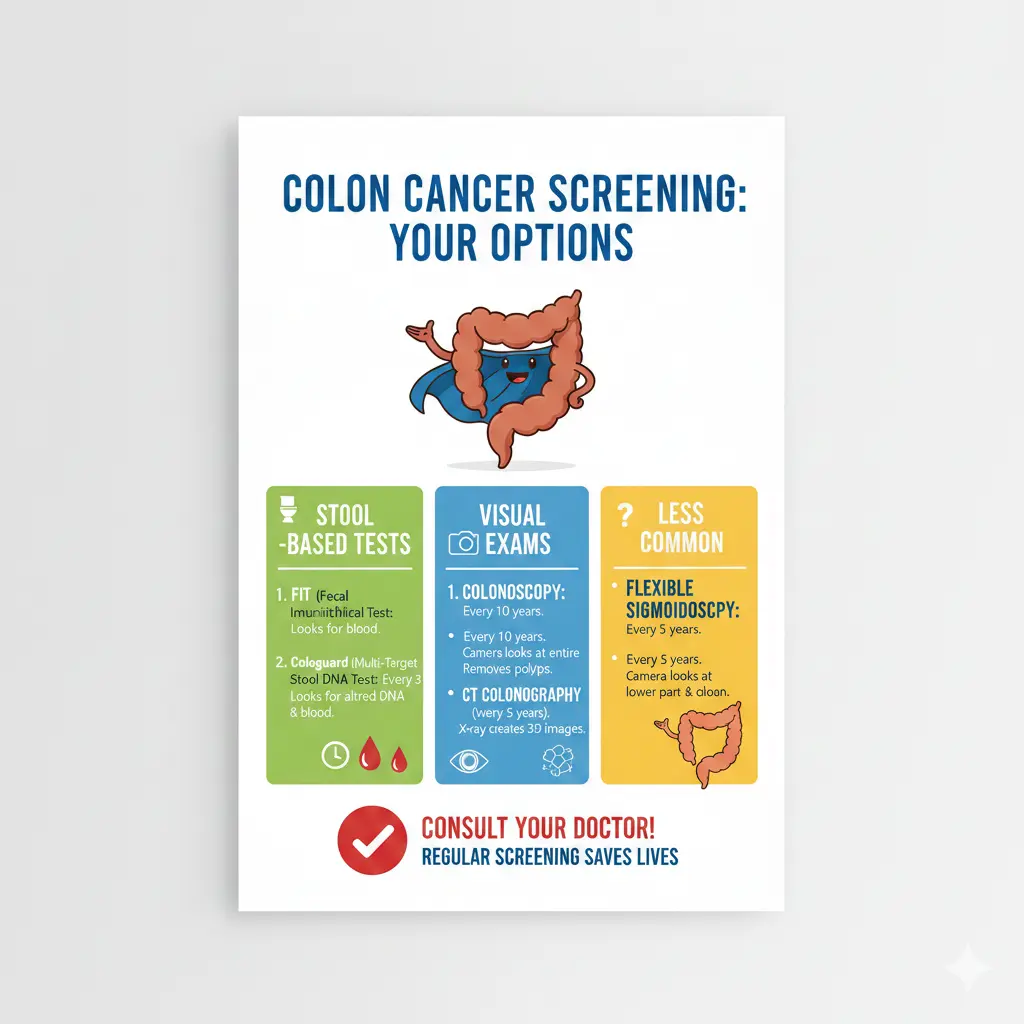
Group 1: Stool-Based Screening Tests (At-Home Options)
These tests analyze stool samples for hidden signs of cancer.
FIT (Fecal Immunochemical Test)
What it detects:
Hidden blood in stool
How it works:
You collect a small stool sample at home and send it to a lab.
Best for:
Average-risk adults
Annual screening
Limitations:
Does not detect polyps directly
Needs yearly repetition
Stool DNA Test (FIT-DNA)
What it detects:
Blood
Abnormal DNA from cancer or large polyps
Best for:
People avoiding colonoscopy
Screening every few years
Limitations:
Higher false positives
Follow-up colonoscopy still required if positive
Group 2: Visual Exams (Preventive Tests)
https://youtu.be/3Ci-Q0J_5Fg?si=wKGO0kvasPCpWDoG
These tests allow doctors to see inside the colon.
Colonoscopy (Gold Standard)
What it does:
Detects cancer
Finds and removes polyps during the same procedure
Why it’s powerful:
It doesn’t just detect cancer—it prevents it.
Typical interval:
Every 10 years for average-risk adults (if normal)
Flexible Sigmoidoscopy
What it examines:
Lower part of the colon
Limitations:
Misses issues in the upper colon
Less commonly used today
CT Colonography (Virtual Colonoscopy)
What it does:
Uses imaging to visualize the colon.
Limitations:
No polyp removal
Follow-up colonoscopy needed if abnormalities are found
Table: Colon Cancer Screening Tests Compared
| Test |
Detects Cancer |
Prevents Cancer |
Frequency |
At Home |
| FIT |
Yes |
No |
Yearly |
Yes |
| Stool DNA |
Yes |
Limited |
Every 1–3 yrs |
Yes |
| Colonoscopy |
Yes |
Yes |
Every 10 yrs |
No |
| Sigmoidoscopy |
Partial |
Partial |
Every 5 yrs |
No |
| CT Colonography |
Yes |
No |
Every 5 yrs |
No |
This comparison reflects real clinical decision-making—not marketing.
UNIQUE SECTION: Practical Insight From Experience
Why Many People Choose the “Wrong” Test
People often choose based on fear, not fit:
Avoid colonoscopy due to anxiety
Choose stool tests without understanding limitations
In practical screening programs, the “best” test is the one a person will actually complete on schedule.
Consistency beats perfection.
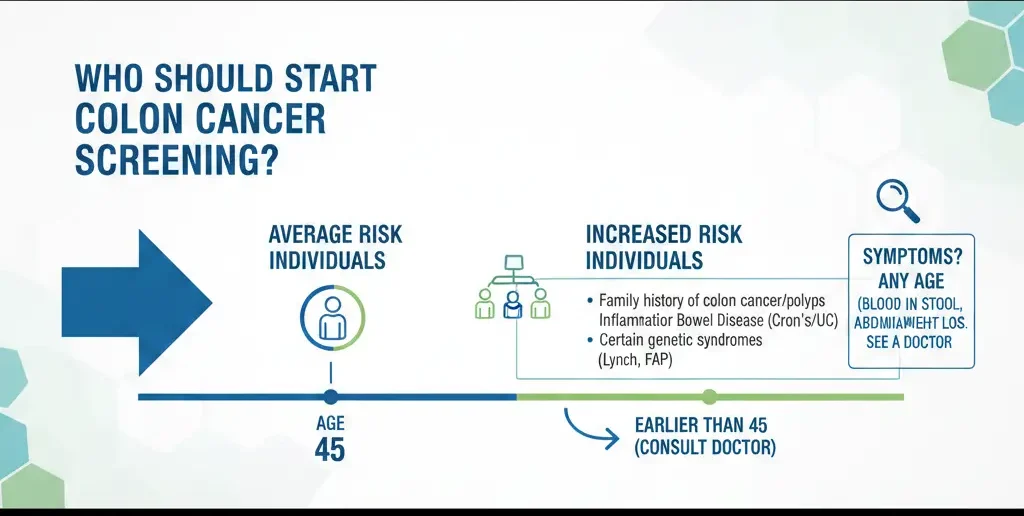
Who Should Start Colon Cancer Screening?
Screening decisions depend on:
Age
Family history
Personal medical history
Most average-risk adults are advised to start screening in mid-adulthood, while higher-risk individuals may need earlier or more frequent testing.
Important: This article explains tests—not individual medical advice.
Common Screening Mistakes (and Smarter Choices)
Mistake 1: Waiting for Symptoms
Fix: Screen based on risk, not symptoms.
Mistake 2: Treating Stool Tests as One-Time
Fix: Repeat them consistently if chosen.
Mistake 3: Assuming Colonoscopy Is Always Required
Fix: Understand all options and discuss preferences.
[Expert Warning]
A positive screening test always requires follow-up, even if you feel well.
How Doctors Choose the Right Screening Test
Clinicians consider:
Risk category
Willingness to repeat testing
Access to procedures
Previous screening results
No single test is “best” for everyone.
[Pro-Tip]
A completed stool test every year is far more protective than a colonoscopy delayed for years.
FAQ
Q1. Which colon cancer screening test is best?
The best test is the one you complete consistently.
Q2. Can stool tests replace colonoscopy?
They can screen, but colonoscopy is needed if results are positive.
Q3. Do screening tests hurt?
Most are painless; colonoscopy involves sedation.
Q4. How often should screening be done?
Depends on the test type and risk level.
Q5. Are screening tests accurate?
All tests have strengths and limitations.
Q6. Can screening prevent colon cancer?
Yes—by detecting and removing polyps early.
Conclusion
Colon cancer screening tests save lives not by reacting to symptoms, but by acting before symptoms appear. Understanding how each test works empowers you to choose an option that fits your risk, comfort, and consistency. When screening is done on time and repeated as recommended, colon cancer becomes one of the most preventable major cancers.
Internal Links
Change in Bowel Habits That Last for Weeks: What It Means - ColonDaily | Your Daily Guide to Colon Health & Wellness
External LinKS
https://www.uspreventiveservicestaskforce.org/uspstf/document/RecommendationStatementFinal/colorectal-cancer-screening?utm